

The Sleep Issue
You’re Sleeping. But Are You Recovering?
By Andrea Nacca, PA-C, FMACP
Founder, HBOT Lounge
You don’t just need more sleep. You need better recovery.
For years, sleep has been treated like something we can borrow from.
Stay up late.
Wake up early.
Push through.
Catch up this weekend.
We talk about sleep as if it is simply the part of the day when nothing is happening.
But your body does not experience sleep as empty time.
It experiences sleep as a different biological state.
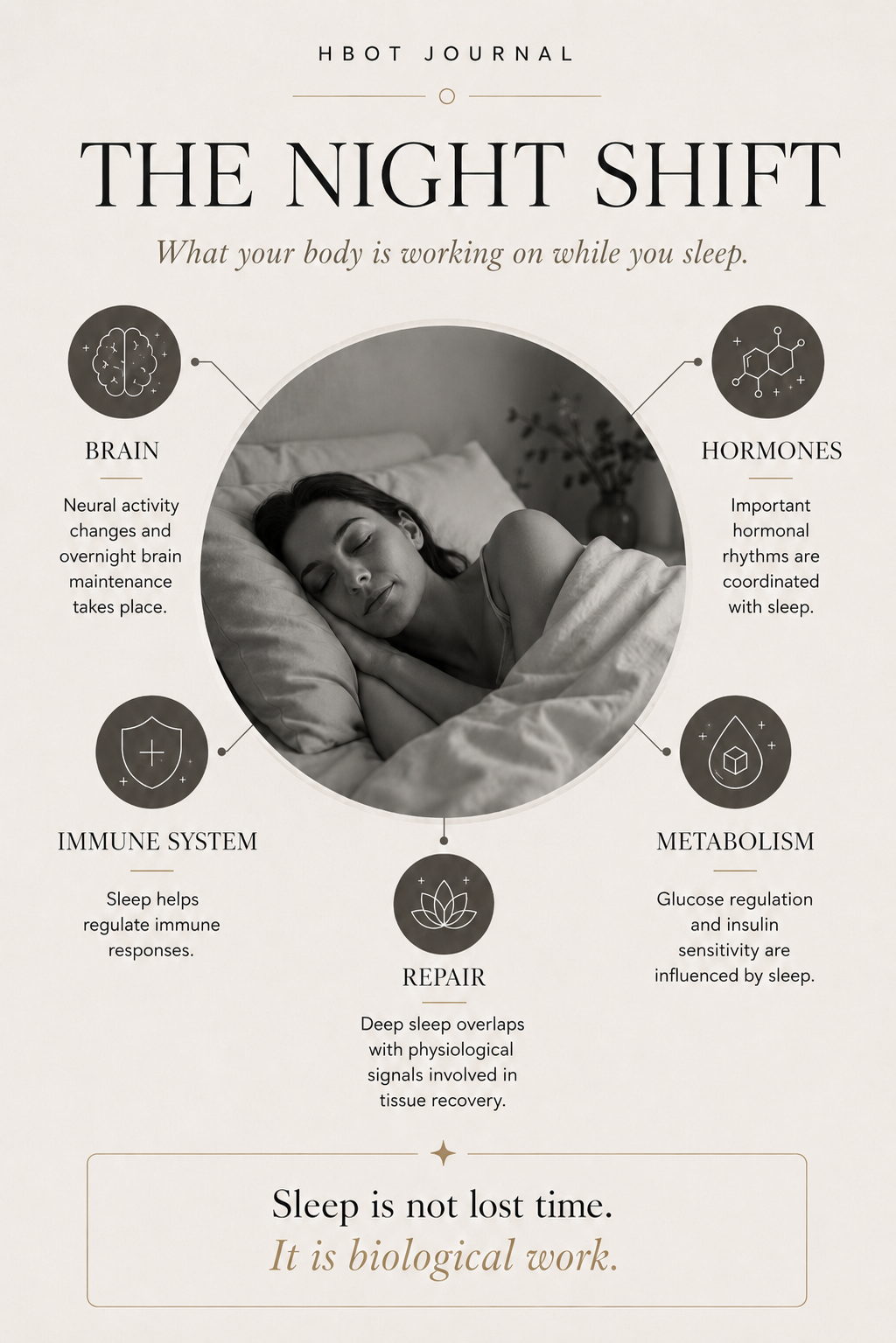
Your brain changes rhythm. Hormone secretion changes. Immune activity changes. Glucose regulation changes. During deeper stages of sleep, growth hormone secretion is closely linked with slow-wave activity, and researchers have even observed large waves of cerebrospinal fluid moving through the brain in synchrony with slow neural activity during non-REM sleep.
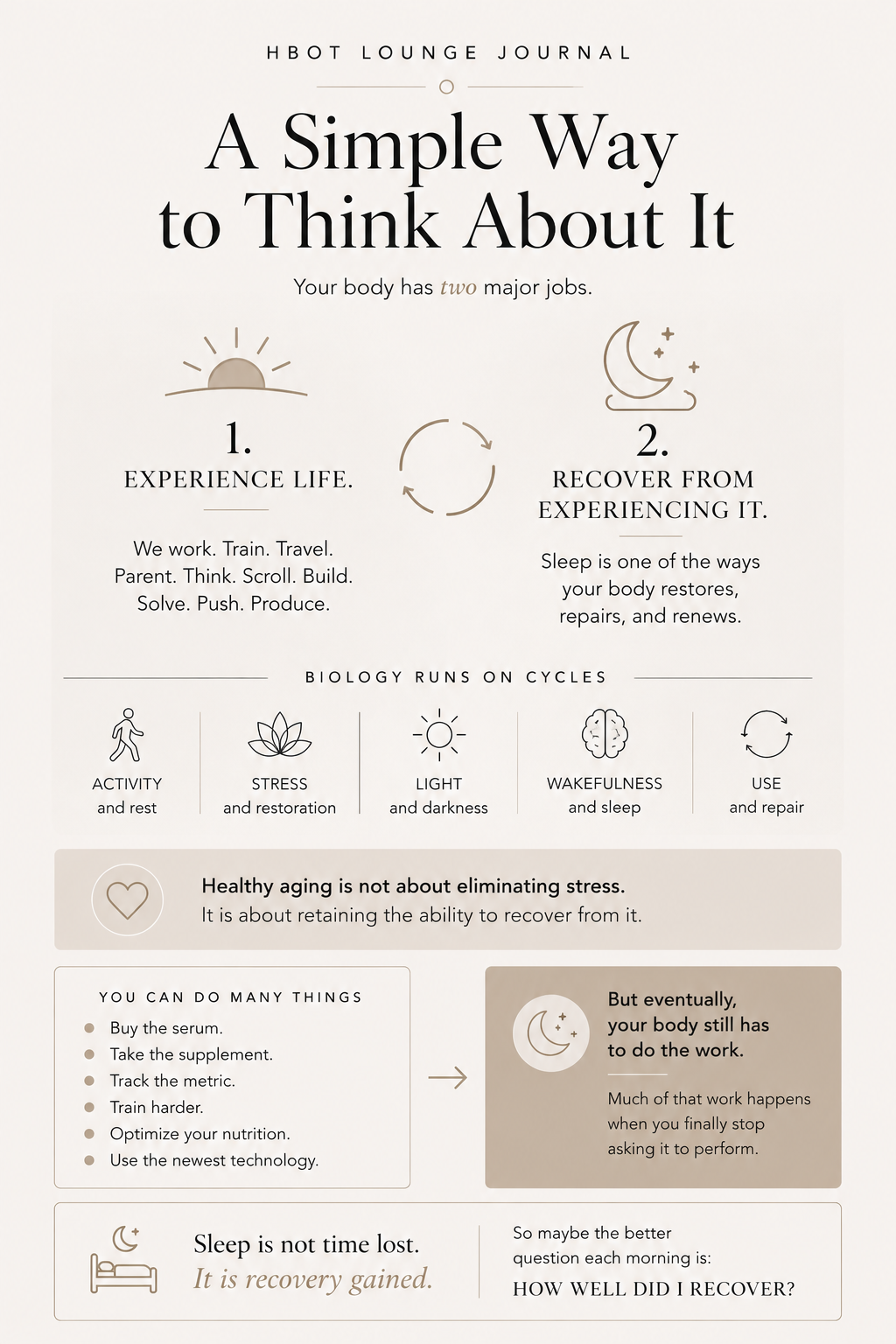
Sleep is not the pause between your days.
It is part of how your body prepares for the next one.
Sleep Is Not a Shutdown. It Is a Shift Change.
Think of your body like a building that stays open all day.
During the day, the lights are on.
People are coming and going.
Energy is being used.
Problems are being solved.
Information is coming in constantly.
Eventually, the building needs a maintenance crew.
Things need to be cleaned.
Systems need to be checked.
Supplies need to be replenished.
Damage needs to be addressed.
Sleep is something like that.
Not everything stops.
The work changes.
Throughout the night, the brain moves repeatedly through non-REM and REM sleep, and different physiological patterns dominate at different points in those cycles.
Slow-wave sleep (deep sleep) is particularly interesting from a recovery perspective. In human studies, a large portion of nighttime growth hormone secretion has occurred in association with slow-wave sleep. Growth hormone participates in tissue growth, metabolism, cellular maintenance, and repair.
The sleeping brain also behaves differently.
Researchers using simultaneous brain imaging and EEG have demonstrated large cerebrospinal-fluid oscillations during non-REM sleep that are coupled with slow neural and blood-flow changes. The exact implications are still being studied, but the finding has helped deepen scientific interest in sleep as an active period of brain maintenance rather than simply unconsciousness.
In other words:
Your body is not doing nothing while you sleep.
It is doing something different.
And some of that work cannot simply be moved to noon tomorrow because you were too busy tonight.
Sleep Debt Leaves a Biological Receipt
One of the problems with poor sleep is that we usually judge it by how tired we feel.
But fatigue is only the part we notice.
Your cells notice it too.
In a landmark laboratory study, restricting healthy adults to four hours of sleep for several nights altered glucose metabolism and endocrine function. In another controlled study, just one week of sleeping approximately five hours per night significantly reduced insulin sensitivity.
Sleep also communicates with the immune system.
In one human experiment, participants who slept normally after receiving a hepatitis A vaccination developed substantially stronger antibody responses than participants who remained awake that night.
Experimental sleep deprivation has also been shown to alter inflammatory signaling.
This is why the conversation about sleep has become much bigger than:
Am I tired?
The better question may be:
What happens to the rest of my biology when recovery is repeatedly interrupted?
That is a longevity question.
Eight Hours Is Not the Whole Story
We love numbers.
Seven hours. Eight hours.
A sleep score of 86.
Thirty-seven minutes of deep sleep.
An HRV of 72.
Those numbers can be useful.
But sleep is not one number.
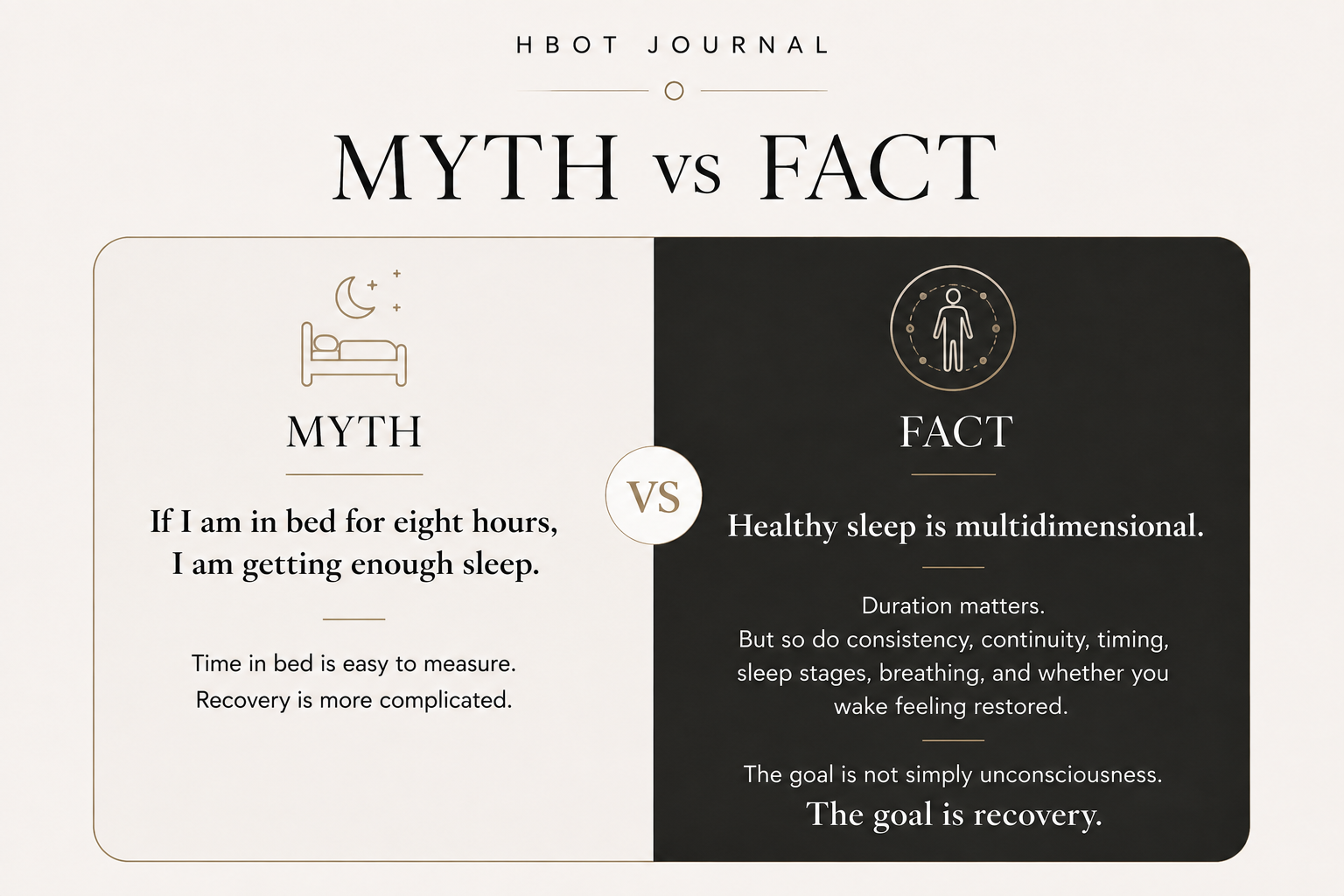
You can spend eight hours in bed and still wake feeling like your body never fully powered down.
Why?
Because restorative sleep depends on more than duration.
There is continuity, timing, regularity, sleep architecture, circadian alignment, breathing.
And the ability of the nervous system to transition away from constant alertness.
That distinction matters.
In large prospective data, greater sleep regularity has been associated with lower mortality risk, and one study found that sleep regularity predicted mortality risk more strongly than sleep duration alone. Because these are observational data, they cannot prove that irregular sleep itself caused the difference, but they reinforce an important point: when and how consistently you sleep may matter alongside how long you sleep.
So perhaps the goal is not simply:
Get eight hours.
Perhaps the goal is:
Create the conditions in which your body can move through sleep well.
Sometimes “I’m Tired” Is Information
There is a difference between occasionally sleeping poorly and repeatedly waking up exhausted.
If you are consistently tired despite giving yourself adequate time to sleep, it may be worth asking why.
Sometimes the problem is behavioral.
Late-night work.
Too much stimulation.
Irregular schedules.
Alcohol.
High-dose caffeine lingering far longer than expected.
Evening light exposure.
Stress that follows you into bed.
But sometimes sleep is being disrupted by something that deserves medical attention.
Breathing disturbances, for example, can repeatedly produce oxygen desaturation, arousals, changes in heart rate, and fragmented sleep without necessarily causing a person to remember waking each time.
That distinction is important.
You cannot out-supplement significant sleep apnea.
You cannot meditate your way around an airway that repeatedly closes.
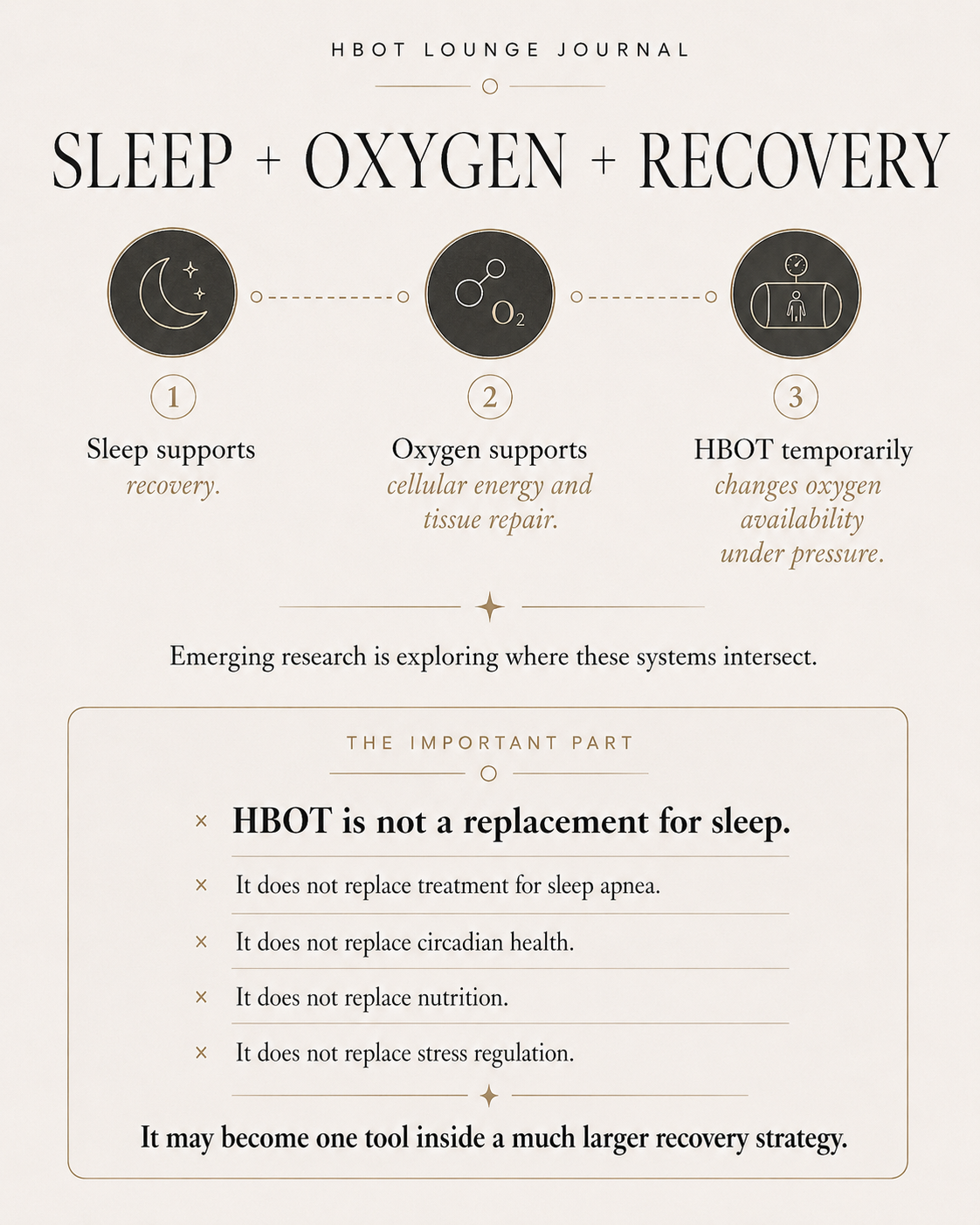
And hyperbaric oxygen therapy does not replace appropriate evaluation or treatment for a sleep disorder.
Sometimes waking up tired is not a character flaw.
It is data.
Where Oxygen Fits In
This is where the sleep conversation becomes especially interesting for us.
Every cell requires oxygen to produce energy efficiently.
The brain requires enormous metabolic support.
Tissue repair requires energy.
And oxygen availability is inseparable from the body's larger recovery physiology.
But that does not mean that simply giving someone more oxygen automatically fixes their sleep.
The relationship is more nuanced.
Hyperbaric oxygen therapy increases the amount of oxygen dissolved in plasma by exposing the body to increased atmospheric pressure with elevated oxygen availability. Depending on the protocol, this can substantially change tissue oxygen exposure during the session.
Researchers are increasingly asking whether some of the downstream biological effects of hyperbaric exposure may influence recovery systems that also intersect with sleep.
And the early findings are interesting.
They are also consistent with something we hear frequently at HBOT Lounge: many of our clients tell us they sleep more deeply, wake feeling more rested, or simply notice that their sleep improves when HBOT becomes part of their recovery routine.
Those experiences are anecdotal, and they are not the same as saying HBOT treats insomnia. But they are encouraging, particularly as researchers continue to explore the relationship between hyperbaric oxygen, recovery, nervous-system function, and sleep.
We are seeing promising signals.
What the HBOT Research Is Beginning to Show
A randomized, sham-controlled study involving U.S. military personnel with persistent symptoms after mild traumatic brain injury examined sleep after 40 hyperbaric sessions. The HBOT group received sessions at 1.5 ATA with greater than 99% oxygen. Researchers found improvement in several components of perceived sleep quality compared with sham, although other sleep measures did not significantly differ.
More recently, a small 2026 controlled crossover study looked specifically at mild hyperbaric oxygen therapy and recovery in 12 male university athletes following exercise-induced fatigue. Participants received 60-minute sessions for six consecutive days at 1.25 ATA with chamber oxygen maintained at 26 to 28 percent. Subjective sleep quality improved after repeated mild hyperbaric sessions compared with the control condition. The study also found changes in measured brain and muscle oxygenation, although it was small, limited to young male athletes, and did not use polysomnography to objectively measure sleep architecture.
Another 2026 study examined 395 patients from several clinical populations who completed a much more intensive medical HBOT protocol of 60 sessions at 2.0 ATA with 100 percent oxygen. Sleep quality scores improved after treatment. However, this was a retrospective observational study without a sham-control group, and the investigators themselves emphasized that regression to the mean, expectancy, improvement in the underlying medical condition, and other factors could have contributed to the results.
That distinction matters.
Different studies use different pressures, different oxygen concentrations, different populations, different numbers of sessions, and different sleep measurements.
So we should not pretend that every chamber protocol is interchangeable.
But taken together, the research raises a worthwhile question:
Could improving the environment in which the body recovers also influence the way we sleep and recover afterward?
There is enough signal to keep asking the question.
You Cannot Hack a Body That Never Feels Off Duty
There is another piece of sleep that deserves more attention.
We spend a lot of time asking:
What supplement should I take?
What device should I buy?
What temperature should my bedroom be?
What is my deep-sleep score?
What is my HRV?
Those things can be useful.
But sometimes the body simply never receives a convincing signal that the day is over.
Phones stay bright.
Work stays open.
Emails stay unanswered.
The news keeps moving.
Caffeine stretches into the afternoon.
The brain receives light long after sunset.
And then at 10:30 p.m. we climb into bed and expect biology to change states immediately.
It does not always work that way.
Experimental studies show that evening light can alter melatonin timing and sleepiness, while controlled caffeine research shows that the effect of caffeine depends heavily on both dose and timing. In a 2025 randomized crossover trial, 400 mg of caffeine affected sleep even when taken many hours before bedtime, while a much smaller 100 mg dose produced far less disruption under the conditions tested.
Your nighttime routine begins before your head touches the pillow.
Sleep is something the body prepares for.
What You Can Do Tonight
You do not need a perfect nighttime routine or a drawer full of sleep supplements.
Often, better sleep begins by giving your biology clearer signals.
Start with the clock.
One of the simplest things you can do is give yourself enough time to actually sleep and keep your schedule reasonably consistent. Your body likes rhythm. A fairly predictable wake time helps reinforce the internal clock that tells you when to feel alert and when to begin winding down. Even on the weekends, try to keep your bed time and wake time within 30 minutes of your normal schedule.
Let the day get darker.
Your brain uses light as information.
Bright light during the day helps reinforce wakefulness. As evening approaches, softer and dimmer light helps communicate that the active part of the day is ending. Dimming your cell phone and placing in night mode, using blue light blocker glasses, or red light can help prepare your body for sleep.
Caffeine deserves a look here too. It is easy to focus only on the time of your last cup, but dose matters as well. A large amount earlier in the day may still be influencing sleep hours later.
Give yourself somewhere to land.
Most of us go directly from stimulation to sleep.
One minute we are answering emails, watching television, scrolling, planning tomorrow, or solving a problem. The next minute we expect the brain to be asleep.
Instead, create a small transition between the two.
It does not need to be elaborate. Lower the lights. Put the work away. Read. Stretch. Take a warm shower. Breathe slowly. Let the decisions stop for the day.
The point is not the ritual itself.
The point is giving your nervous system a clear signal that it no longer needs to perform.
And listen to what your sleep is telling you.
If you consistently give yourself enough time to sleep and still wake exhausted, look deeper rather than simply adding another sleep hack.
Loud snoring, gasping, witnessed pauses in breathing, frequent awakenings, morning headaches, or persistent nonrestorative sleep deserve attention.
And while wearables can be incredibly useful for spotting patterns, try not to let a sleep score become the goal.
Your tracker is collecting data.
Your body is the outcome.
The real question is not whether your device gave you a perfect score.
It is whether you wake feeling restored enough to live the day in front of you.
Research We Looked At
For the journal page, I would hyperlink these exactly the way you did in the Skin Issue: